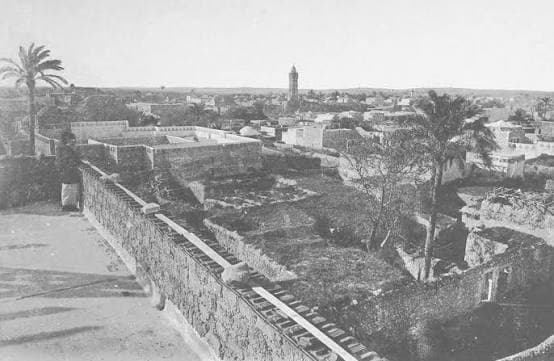
A historical black-and-white photograph of old Gaza — a stone rampart wall in the foreground, date palms and terraced gardens, low earthen buildings, and a slender minaret rising against a pale sky

Gaza Heritage Museum

Painted from Memory

Seventeen sites that carried five thousand years of Gaza's history. Bronze Age cities, Byzantine churches, Mamluk palaces, Ottoman houses. This is a virtual museum for buildings that no longer stand, kept as documented memories: what each one was, its condition today, and the source for that assessment.

Sites documented
17
UNESCO-verified damage
164 sites
Span
3300 BCE — today

Since October 2023, UNESCO has verified damage to 164 cultural sites in Gaza. Among them 14 religious sites, 9 monuments, 8 archaeological sites, and 2 museums, as of March 2026.

Each site below carries its most recent verified status. Where sources conflict, the disputed extent is noted rather than resolved. Condition marks: destroyed, damaged, intact-at-risk, or unverified.

The collection

Seventeen sites documenting World History

Every card is an accession record. It states what the site was, its condition today, and the source for that assessment. Where a young artist of the Mayasem Association painted the site from memory, that painting stands in for a photograph that can no longer be taken.

Bronze AgeIron AgeClassical / ByzantineIslamic
12th c. CE standing structure

Great Omari Mosque

المسجد العمري الكبير

Old City, Gaza

The oldest and largest mosque in Gaza, on ground held sacred for millennia — a Philistine temple to Dagon, a Roman temple, and a 5th-century Byzantine church. The standing building grew out of the Crusader Cathedral of St. John, raised in 1149 CE and converted after Saladin's reconquest.

Destroyed
800 BCE – 600 CE

Anthedon Harbour

ميناء أنثيدون

Sheikh Ijlin, north Gaza

Gaza's first known seaport, with features spanning the Iron Age to the Byzantine era. As the city's main harbour under Hellenistic and Roman rule it handled incense, spices, and luxury goods; excavation exposed warehouses, a basilica, and mosaics.

Destroyed· bulldozed
13th c. CE

Qasr al-Basha

قصر الباشا

Old City, Gaza

A fortified Mamluk palace that later housed Napoleon during his 1799 Egyptian campaign, and in modern times a school and archaeological museum holding more than twenty thousand catalogued artefacts.

Destroyed
13th–14th c. CE

Hammam al-Samra

حمّام السمرة

Old City, Gaza

The last functioning historic bathhouse in Gaza, in near-continuous use for centuries. Its domed chambers with star-shaped skylights and hypocaust heating carried the Roman bathing tradition into Islamic urban life.

Destroyed
5th–6th c. CE

Jabaliya Byzantine Church

الكنيسة البيزنطية في جباليا

Jabaliya, north Gaza

A Byzantine church whose polychrome mosaic floors — animals, birds, and Greek inscriptions — rank among the finest examples of the form in the region, part of a larger ecclesiastical complex.

Damaged· extent disputed
425 CE

Church of Saint Porphyrius

كنيسة القديس برفيريوس

Zeitoun Quarter, Gaza

The oldest active church in Gaza, holding the tomb of the bishop who Christianised the city. It has stood through earthquakes, invasions, and wars for more than 1,600 years.

Damaged· annex destroyed
3300–2000 BCE

Tell es-Sakan

تل السكن

South Gaza

The earliest known fortified town in the Gaza region and a rare Egyptian colonial settlement, founded around 3300 BCE. Its mudbrick defences and planned street grid document the shift from Egyptian outpost to Canaanite city.

Damaged
2000–1550 BCE

Tell el-Ajjul

تل العجول

South of Gaza City

A major Canaanite city with strong Egyptian ties, whose excavation yielded the celebrated 'Gaza Gold' — exquisite jewellery attesting to Bronze Age Gaza's wealth and its place in ancient trade networks.

Damaged
rebuilt 12th c. CE

Al-Sayed Hashim Mosque

مسجد السيد هاشم

Old City, Gaza

A mosque believed to hold the tomb of Hashim ibn Abd Manaf, great-grandfather of the Prophet Muhammad, making it both a pilgrimage site and a link to early Islamic history.

Damaged· extent disputed
4th–7th c. CE

Saint Hilarion Monastery

دير القديس هيلاريون

Tell Umm el-Amr, Nuseirat

One of the largest monastery complexes in the Middle East, founded by Saint Hilarion, father of Palestinian monasticism. Its 2.5 acres hold five successive churches, crypts, mosaics, and a Roman-style bathhouse. Inscribed on the UNESCO World Heritage List and its List of World Heritage in Danger in 2024.

Intact· at severe risk
1387 CE

Barquq Castle

قلعة برقوق

Khan Yunis, south Gaza

A Mamluk fortified caravanserai raised by order of Sultan az-Zahir Barquq to shelter caravans on the Egypt–Levant road. The town of Khan Yunis grew up around it and took its name from it.

Condition unverified
14th c. CE

Souk al-Qissariya

سوق القيسارية

Old City, Gaza

A covered market beside the Great Omari Mosque, historically Gaza's gold and textile bazaar. Its vaulted lanes of stone arches and timber awnings preserve the fabric of the medieval souk.

Condition unverified
1661 CE

Al-Saqqa House

دار السقا

Shuja'iyya, Gaza

One of the oldest surviving traditional houses in Gaza, built by the al-Saqqa family in the 17th century and known for its carved stonework, arched courtyard, and grand open staircase.

Condition unverified
Ottoman period

Al-Ghalayini House

دار الغلاييني

Old City, Gaza

A courtyard mansion of the Ghalayini family, built in the Ottoman-Palestinian style with arched galleries around a central court — the intimate scale and craftsmanship of old Gaza's family residences.

Condition unverified
Ottoman period

Sibat al-Alami

سباط العلمي

Old City, Gaza

A covered passageway (sabat) in the Old City where a room bridges over a lane linking historic quarters — a characteristic thread of the Ottoman urban fabric, offering shade and connecting neighbouring houses.

Condition unverified
medieval period

Maqam al-Khidr

مقام الخضر

Deir al-Balah, central Gaza

A shrine to al-Khidr, venerated by Muslims and identified by Christians with Saint George. Its vaulted, lamp-lit interior has drawn shared pilgrimage and devotion across faiths for centuries.

Condition unverified
3rd millennium BCE – Roman era

Tell Rafah

تل رفح

Rafah, south Gaza

The settlement mound of ancient Raphia on the Egypt–Palestine frontier, inhabited from the Bronze Age and site of the 217 BCE Battle of Raphia between Ptolemy IV and Antiochus III.

Condition unverified

Chronology

Five thousand years, one place

Gaza sat on the road between Egypt and the Levant, so nearly every empire of the ancient world passed through and left something behind. The sites in this collection are the surviving marks of that traffic.

  1. 3300 BCETell es-Sakan fortified city established
  2. 1500 BCEGaza named in Egyptian records (Tell el-Ajjul)
  3. 1200 BCEPhilistines make Gaza one of five city-states
  4. 332 BCEAlexander the Great takes Gaza after a siege
  5. 217 BCEBattle of Raphia fought at Tell Rafah
  6. 63 BCEPompey restores Gaza to Roman control
  7. 395 CESaint Hilarion Monastery founded
  8. 425 CEChurch of Saint Porphyrius constructed
  9. 637 CEMuslim conquest of Gaza
  10. 1149 CECrusaders build the cathedral later the Great Omari Mosque
  11. 1387 CEBarquq Castle raised at Khan Yunis
  12. 1517 CEOttoman conquest of Gaza
  13. 1799 CENapoleon stays at Qasr al-Basha

Why this museum exists

A record kept by the next generation

This is a project launched by Al Hub Forum, and maintained by the Jerusalem Academy of the Arts. Students in Chicago research these endangered sites while their counterparts in Gaza respond to them in their own work — the paintings throughout this museum are theirs.

The heritage paintings and the Children of War exhibit were made by young artists of the Mayasem Association for Culture and Arts in Al Mawasi, Gaza. When a photograph can no longer be taken, a painting from memory becomes the record. This museum is how a heritage under erasure is kept alive, in the hands of the children who remember it.

In partnership with

Mayasem Association for Culture and Arts

A Gaza-based cultural organization that nurtures the artistic voice of displaced children and young people through workshops in painting, music, and storytelling — the program that made these paintings possible.